


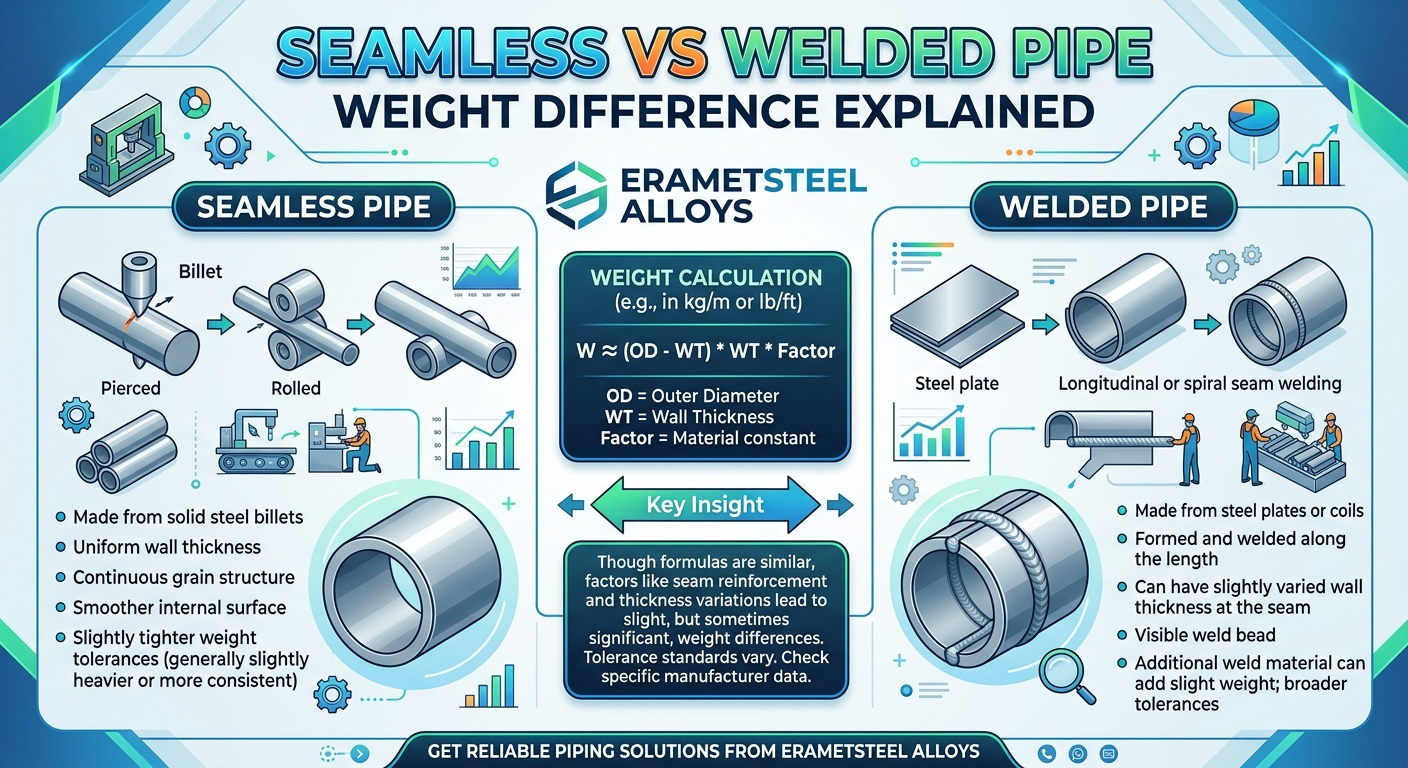
Seamless vs Welded Pipe Weight Difference Explained
When selecting pipes for industrial, construction, or sanitary applications, understanding the difference between seamless pipe weight and welded pipe weight is essential. While both types may look similar, their manufacturing process, thickness, and weight variations can impact performance and cost.
This guide explains seamless pipe weight, welded pipe weight, pipe manufacturing differences, and SS seamless pipe weight calculations with tables and charts.
What is a Seamless Pipe?
A seamless pipe is manufactured without any welding joints. It is made by extruding a solid billet, resulting in a uniform structure.
Key Features:
- No weld seam
- Higher strength
- Uniform thickness
- Used in high-pressure applications
What is a Welded Pipe?
A welded pipe is made by rolling a steel plate or strip and welding the seam longitudinally.
Key Features:
- Visible weld seam
- Cost-effective
- Slight thickness variation
- Used in low to medium pressure systems
Pipe Manufacturing Difference
Feature | Seamless Pipe | Welded Pipe |
Manufacturing | Extrusion | Rolling + Welding |
Strength | High | Moderate |
Cost | Expensive | Affordable |
Uniformity | Excellent | Slight variation |
Seamless Pipe Weight vs Welded Pipe Weight
Core Difference:
- Seamless pipe weight is usually slightly higher due to uniform thickness and tighter tolerances
- Welded pipe weight may be slightly lower or inconsistent due to weld seam and thinner walls
Pipe Weight Formula (Applicable to Both)
Weight (kg/m) = (OD − WT) × WT × Constant
- For Mild Steel: 0.02466
- For Stainless Steel: 0.02491
Example Comparison
Let’s compare both pipes:
- OD = 100 mm
- WT = 5 mm
Seamless Pipe:
Weight = 11.71 kg/m (accurate, uniform)
Welded Pipe:
Weight ≈ 11.4 – 11.7 kg/m (may vary slightly)
👉 Insight: The difference is small but important in precision industries.
SS Seamless Pipe Weight Table
OD (mm) | WT (mm) | Weight (kg/m) |
25 | 2 | 1.15 |
50 | 2 | 2.39 |
75 | 3 | 5.34 |
100 | 4 | 9.46 |
150 | 5 | 17.72 |
Welded Pipe Weight Table (Approx)
OD (mm) | WT (mm) | Weight Range (kg/m) |
25 | 2 | 1.10 – 1.15 |
50 | 2 | 2.30 – 2.39 |
75 | 3 | 5.20 – 5.34 |
100 | 4 | 9.20 – 9.46 |
150 | 5 | 17.40 – 17.72 |
Visual Weight Difference Chart
Seamless vs Welded Comparison
Pipe Type | Weight Accuracy | Variation |
Seamless | High | Minimal |
Welded | Medium | Slight |
Why Weight Difference Matters
Understanding pipe weight differences helps in:
- Load calculation and support design
- Cost estimation
- Material selection
- Transport planning
For industries like oil & gas, pharma, and dairy, even small differences matter.
When to Choose Seamless Pipes
Use seamless pipes when:
- High pressure is involved
- Precision is required
- Safety is critical
When to Choose Welded Pipes
Use welded pipes when:
- Budget is limited
- Pressure is low to medium
- Large diameter pipes are needed
Pro Tips
- Always check tolerance levels
- Consider application type
- Use seamless pipes for critical systems
- Use welded pipes for cost efficiency
Conclusion
The difference between seamless pipe weight and welded pipe weight is usually small but significant in critical applications. Seamless pipes offer better uniformity and strength, while welded pipes provide cost advantages.
Choosing the right pipe depends on your project requirements, pressure conditions, and budget.